
The process
Pre-cycle assessment
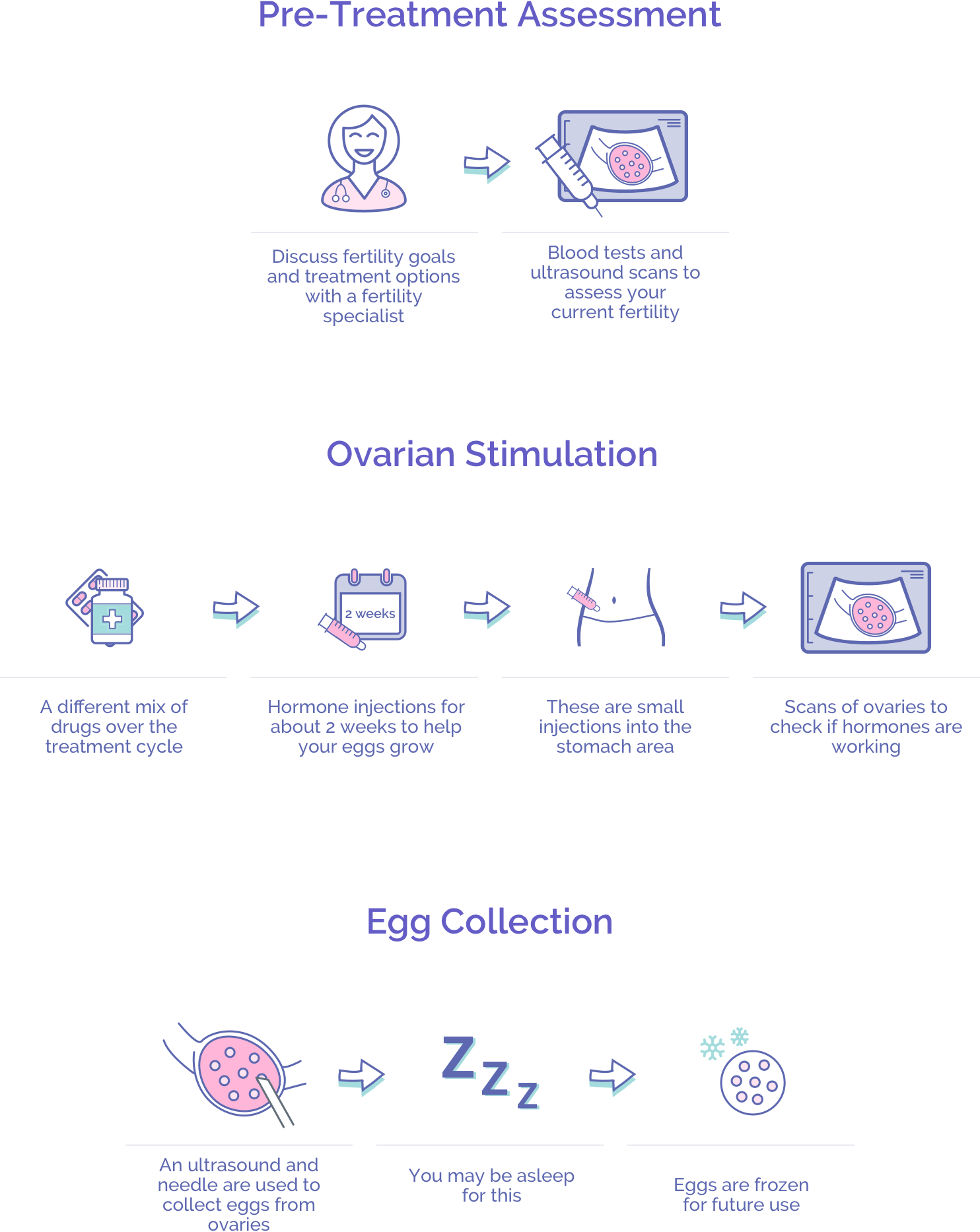
Before egg freezing, a fertility specialist may:
- Discuss your fertility goals
- Discuss your options for achieving these goals
- Run tests such as blood tests and ultrasound scans to assess your current fertility and check if egg freezing is safe for you
Sometimes hormone levels (including AMH
) are measured to try and estimate the number of eggs that might be collected. These tests can only provide an estimate and are not very accurate when predicting the likelihood of becoming pregnant with or without using frozen eggs (10). For more information about AMH
click here.
Discussing your test results with a fertility specialist
will be important when trying to decide whether or not to freeze your eggs.
The number of appointments you have with a fertility specialist
before starting an egg freezing cycle will vary, however at least 1-2 are needed to discuss the results of your fertility tests and decide on a plan together.
Ovarian stimulation
The first step of egg freezing is ovarian stimulation.
This is where:
- Hormone injections are needed for around 8-12 days to stimulate the ovaries and mature as many eggs as possible.
- The injections are usually given into a pinch of skin around the stomach area. The needle is small and has been described as a tiny prick on the skin. Ice can be used to numb the area if needed.
- Other medications might be needed too.
During this time, your fertility specialist or a member from your fertility clinic will monitor how well your eggs are maturing using transvaginal ultrasound scans and/or blood tests.
The number of appointments you will need during this time can vary but typically, women have 3-4 appointments during the 2-week period. Flexibility will be needed during this time. You may require taking time off work and/or other commitments at short notice.
Some women feel worried about self-injecting incorrectly, pain, and accidentally causing harm to themselves (11). A member from your fertility clinic will teach you how to inject these hormones properly. You can also ask someone to help you with the injections if needed.
The hormones used for ovarian stimulation can cause side-effects, and although rare, some complications can happen too. It is difficult to predict what (if any) side-effects someone will experience as they vary from person to person. For more information click here.
Timing of egg collection
The timing of egg collection depends on how long it takes for your eggs to mature. Generally, this takes around two weeks. Usually, a minimum of 2 days’ notice is given to prepare for an egg collection procedure.
Egg collection procedure
Egg collection is a minor surgery. It involves inserting an ultrasound probe into the vagina, and a needle into each follicle to collect the eggs from the ovaries.
The procedure takes around 5-10 minutes, depending on how many follicles you have. What you feel will depend on the type of anaesthetic used by your fertility clinic.
Usually, you would not return to work the day of the procedure, and someone may need to pick you up from the clinic and stay with you overnight. It is generally recommended taking 1-2 days off work to recover after the procedure. Some women might need more time.
Some patients may experience cramping and light bleeding for a few days after their egg collection procedure. Over the counter pain relief can be used to help (e.g. paracetamol or ibuprofen). If pain relief does not help it is important to contact your fertility clinic.
Depending on your clinic, you may have a follow up appointment after the procedure to discuss the outcome. When contacting a clinic about egg freezing you may like to ask about their follow up procedures.
Egg freezing can be physically and emotionally difficult for patients. Click here for some examples of self-care that might be helpful during this time.
Egg freezing and storage
Some eggs collected may be unsuitable for freezing and will be discarded. Click here for more information about egg collection rates.
Eggs that are suitable for freezing will be frozen and stored until you decide to use, dispose, or donate them to another woman or to research (no babies will be made from research – it is illegal).
You will need to pay ongoing fees to store your frozen eggs. Click here for more information about storage costs.
If you decide to use your frozen eggs in the future, you will need to have another IVF procedure. Not every egg will survive the thawing process. Click here for more about using frozen eggs, and here for success rates.
How long does a cycle take?
Cycle times vary, however on average they take about 2 weeks to complete.
If the first cycle does not result in many mature eggs, you may want to have more cycles. This will increase the time and costs required.
On average, women tend to have 1 or 2 egg freezing cycles (12). If you decide to have more you may want to start immediately (however this will depend on medical advice), or wait to decide if you want to go through another cycle again.